Siga-nos


Siga-nos
categorias
recente Postagens
Quick Answer:Selected thermoplastic daylight fluorescent pigments may be suitable for solvent-based inks when matched with the right solvent–binder system. iSuoChem also offers solvent-resistant fluorescent pigment grades specifically recommended for solvent-based inks, including thermosetting-resin options.
This article focuses onresin-carrier daylight fluorescent pigments (DFPs): solid particles in which fluorescent dyes are molecularly dispersed in an organic resin. It does not cover inorganic phosphors, quantum dots, soluble fluorescent dyes or ready-made liquid dispersions, which have different structures and application behavior.
Here, "thermoplastic" describes the resin carrier inside the pigment particle---not the ink binder or every pigment marketed for plastics. Thermoplastic resins generally soften when heated, whereas thermoset resins form a more permanently crosslinked structure during curing. This distinction can influence solvent response, but the specific resin chemistry and formulation still determine compatibility. A product label such as "plastic grade" or "ink grade" should therefore be checked against the supplier's carrier information and application guidance.
Daylight fluorescent pigments differ from conventional inorganic or organic pigment crystals. They are transparent resin particles containing fluorescent dyes in molecular solution. The resin separates the dye molecules, converts the colorant into a dispersible solid and helps preserve the optical conditions required for fluorescence [2].
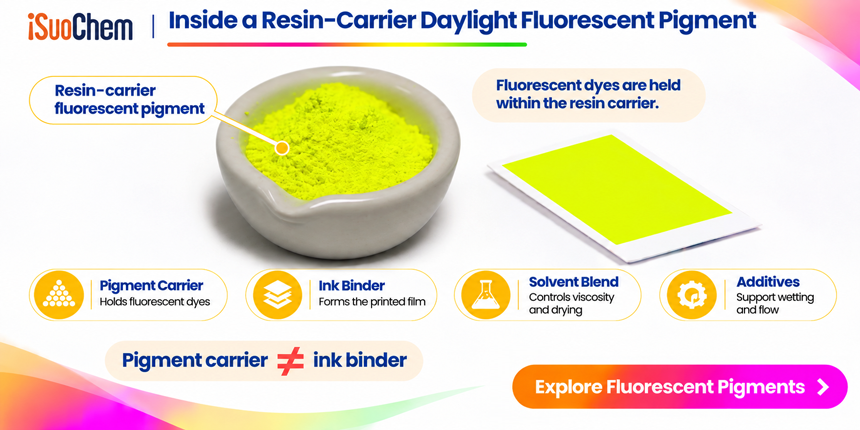
This internal resin is thepigment carrier. It is not the same material as the ink binder, even when both are polymers. A solvent-based ink therefore contains several distinct components:
· a daylight fluorescent pigment with its own resin carrier;
· an ink binder that forms the printed film;
· a solvent blend that controls viscosity, drying and application;
· additives that influence wetting, adhesion, flow or resistance;
· a substrate and, in some applications, adjacent coatings or adhesives.
Confusing these roles can lead to poor selection decisions. A pigment intended for plastic coloration may be designed mainly for heat and dispersion in molten polymer, while a pigment for solvent ink must remain stable in the liquid vehicle during manufacture and storage. Ask the supplier to confirm the carrier chemistry and recommended application.
The resin matrix also affects fluorescence. Dye molecules need to remain sufficiently separated; excessive concentration can promote quenching or reabsorption and reduce visible brightness [2]. Apparent fluorescence loss may also result from film opacity, pigment concentration, dispersion, substrate color or changes in the dye's local environment---not necessarily dye decomposition.
Research by Álvarez-Martín and co-workers found that early commercial daylight fluorescent pigments used melamine-based thermoplastic resin carriers. The authors described their solvent and light stability as moderate and identified swelling as a main disadvantage. They also discussed the later development of thermoset versions with a higher proportion of melamine to improve stability [1].
These findings describe early products; they should not be assumed to represent every current commercial grade. Carrier chemistry and additives can vary between formulations, and detailed compositions are often proprietary.
A separate study by Mambetova, Irgibaeva and Mantel prepared thermoplastic resin-carrier fluorescent pigments and assessed organic-solvent resistance by measuring the amount of colorant washed out of the carrier. The results indicate that formulation and curing chemistry affect solvent resistance [3]. Because the study examined self-prepared pigments rather than a broad range of commercial ink formulations, it is best read as evidence that resistance can be improved in a particular thermoplastic formulation---not as proof of universal compatibility.
Alcohols, esters, ketones, aromatic hydrocarbons and glycol ethers are often grouped into simple "weak" and "strong" solvent categories. These labels may help with preliminary screening, but they are not universal compatibility rules for resin-carrier DFPs.
A solvent's effect depends on its chemical affinity for the specific polymer, as well as molecular size, polarity, hydrogen bonding, temperature and contact time. Solvent blends, binders and additives also change the liquid environment around the pigment. A compatibility screen should therefore reproduce the customer's actual solvent proportions, binder and important additives.
Solvent volatility does not determine pigment compatibility during storage. In a properly sealed ink container, the pigment remains exposed to the liquid vehicle throughout the storage period, regardless of how quickly individual solvents evaporate during printing.
Failure normally develops as a sequence rather than as immediate dissolution.
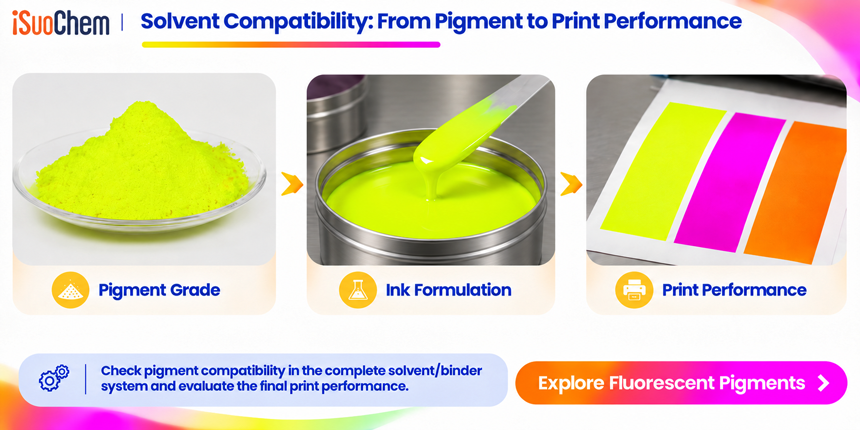
The liquid vehicle first wets the pigment surface and displaces air. Appropriate wetting is necessary for uniform incorporation, but a pigment that disperses easily on the day of manufacture may still be unstable during storage.
Solvent molecules can gradually penetrate the resin carrier. The rate depends on the carrier chemistry, solvent blend, temperature and exposure time. The swelling tendency reported for early thermoplastic daylight fluorescent pigments shows why an immediate drawdown cannot establish long-term compatibility [1].
As the carrier absorbs liquid, the particle may soften or swell. The dispersed phase can then occupy a larger effective volume and interact differently with the surrounding vehicle. The ink may become thicker, stringier or harder to transfer.
Set the acceptable viscosity range according to the printing process, and measure it using a defined instrument, temperature and shear condition---or a specified flow cup.
If the liquid phase has sufficient affinity for the carrier, part of the fluorescent colorant may leave the particle and enter the surrounding vehicle. This can appear as staining, loss of edge definition or color transfer into a white overcoat.
Bleeding should be distinguished from migration. Bleeding describes color released into a contacting medium. Migration describes later movement through a dried film, substrate, adhesive, laminate or adjacent coating. An ink can appear stable in the container and still fail after printing if a neighboring material changes the chemical environment.
Reduced fluorescence may accompany carrier damage or colorant extraction, but other causes should also be checked. Compare aged and unaged drawdowns at the same dry-film weight, on the same substrate and under controlled illumination. Differences in thickness, opacity, substrate color or dye concentration can otherwise be mistaken for chemical failure [2].
Use the following comparative screening program with the actual ink, printing process and end use in mind. Define test conditions and acceptance limits before testing so that candidate grades can be compared consistently.
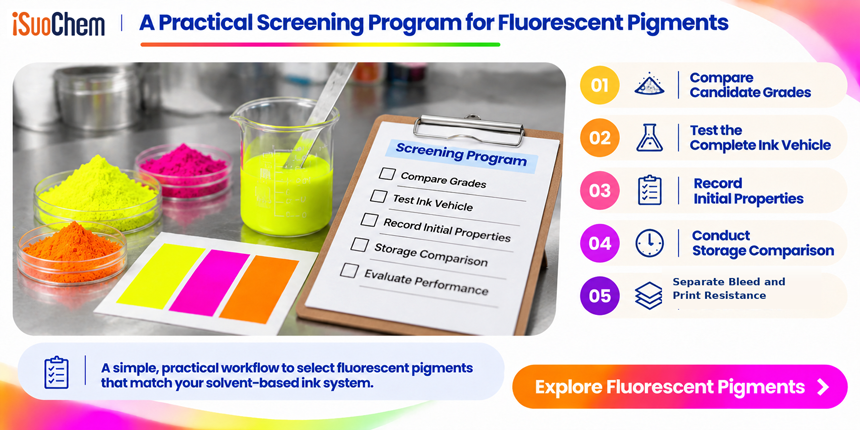
When the solvent window is uncertain, do not evaluate only one grade. Compare the candidate thermoplastic pigment with a product specifically documented for improved solvent resistance. Where appropriate, include a thermoset or crosslinked grade.
Keep the required product form clear. An insoluble pigment, a soluble fluorescent colorant and a liquid dispersion are not interchangeable. They differ in transparency, migration behavior, incorporation and storage requirements.
Use the real binder, solvent proportions, pigment concentration and important additives. A pigment--solvent contact test can provide a rapid indication of color extraction, but it cannot predict the rheology, print transfer, adhesion or film formation of the complete ink.
Prepare an unaged control and process every candidate under the same conditions. Record mixing equipment, time, temperature and addition sequence so that later differences can be attributed to the pigment rather than to uncontrolled preparation.
Before storage, document:
· viscosity using a defined instrument and temperature, or a specified flow cup;
· flow, stringiness and visible gel particles;
· filtration residue through a production-relevant screen;
· settlement and redispersibility;
· drawdown shade, gloss, leveling and surface cleanliness;
· fluorescence under fixed illumination, geometry and film weight.
For visual records, keep exposure, light source, viewing distance, substrate and film weight consistent. Instrumental color or fluorescence measurements are preferable when available.
Select storage times and temperatures using the company's established ink-stability procedure. Room-temperature and elevated-temperature samples can help reveal delayed swelling, extraction or separation.
After storage, condition samples to the specified measurement temperature and repeat the initial measurements and drawdowns. Do not translate an accelerated-aging result into a room-temperature shelf life unless that relationship has been validated for the formulation.
ASTM D279-02(2023) distinguishes two pigment-bleeding methods. Method A evaluates color produced when adry pigmentcontacts a selected solvent; the default solvent is toluene, although another solvent may be used by agreement. Method B observes color migration into a white coating applied over a pigmented base coat [4].
ASTM D279 evaluates pigment bleeding; it is not a liquid-ink storage-stability test and does not model every adhesive laminate or packaging interface. It also does not set a universal pass/fail limit for finished fluorescent inks.
For resistance of the finished print to solvents and other agents, ISO 2836:2021 is more directly applicable. It covers printed materials produced by gravure, flexography, screen, offset, inkjet and electrophotographic processes [5]. This print-level assessment still does not replace liquid-ink storage testing; the two questions should be evaluated separately.
|
Stage |
What to record |
Main warning signs |
|
Initial ink |
Viscosity, flow, filtration residue, and appearance |
Gel, stringiness, or unusually high residue |
|
Stored ink |
Same viscosity method, settlement, and redispersibility |
Progressive thickening, separation, or hard settlement |
|
Drawdown |
Shade, fluorescence, gloss, and leveling |
Color shift, roughness, or lower brightness |
|
Bleed check |
Solvent extract or white-overcoat comparison |
Visible staining or loss of edge definition |
|
Finished print |
Resistance under an end-use-relevant method |
Transfer, staining, film damage, or adhesion loss |
Record each result against the unaged control and the other candidate grades. Comparative results are more useful than a simple "no visible change" statement without documented test conditions.
Direct published data linking grinding energy to fluorescence loss in resin-carrier DFPs are limited. Avoid excessive grinding as a processing precaution, and set the endpoint using measured results rather than a universal speed or time.
A project-specific endpoint can still be defined before processing:
· no visible dry pigment or persistent agglomerates;
· a repeatable drawdown at fixed film weight;
· filtration residue no longer improving with additional mixing;
· viscosity stable over the final sampling interval;
· batch temperature within the product or plant limit.
Continue processing only while a measured output improves. Stop if additional mixing raises temperature without improving filtration, film appearance or color uniformity. Validate mixer speed, milling time and grind endpoint for the selected pigment, vehicle and equipment.
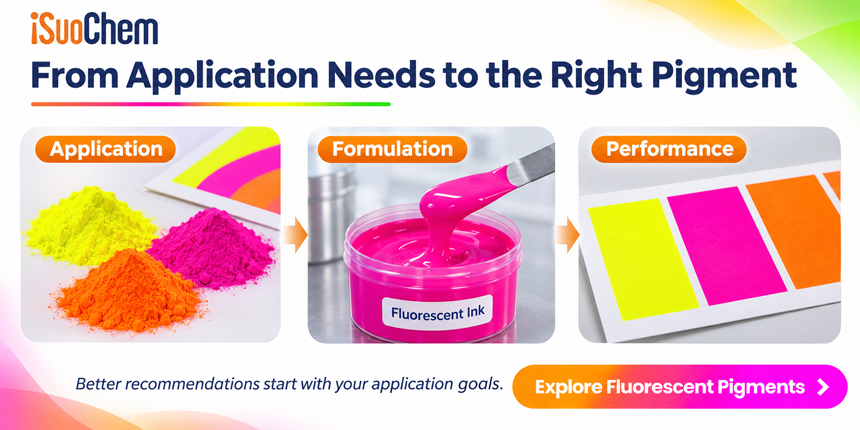
"A daylight fluorescent pigment for solvent ink" is not enough information for reliable grade selection. A useful technical inquiry should include:
· the complete solvent blend and approximate proportions;
· the binder chemistry;
· the target pigment concentration;
· important dispersants, plasticizers or adhesion promoters;
· the printing process and operating viscosity range;
· the substrate and any neighboring coating, adhesive or laminate;
· drying conditions and expected storage period;
· required fluorescence, gloss, transparency and bleed resistance;
· relevant regulatory or restricted-substance requirements.
Also confirm whether the application requires a solid resin-carrier pigment or a different product form, such as a soluble fluorescent dye or prepared liquid dispersion. These materials are not interchangeable and should not be compared as equivalent grades.
For help selecting a fluorescent pigment for solvent-based inks, contact iSuoChem with your solvent blend, binder chemistry, printing method and target color. Our team can discuss suitable grades and sample options based on your application requirements.
Thermoplastic resin-carrier DFPs may be suitable for selected solvent-based inks, but the right choice depends on the pigment carrier, solvent blend, binder and printing conditions. Research documents swelling in early thermoplastic grades and shows that improved organic-solvent resistance can be engineered in particular formulations [1,3].
Before production, test the candidate in the complete ink vehicle and assess storage stability, pigment bleeding and finished-print resistance separately. When solvent resistance is the priority, compare thermoplastic candidates with grades specifically documented for solvent-based inks rather than selecting by resin-family label alone.
[4] ASTM International. (2023). ASTM D279-02(2023), Standard Test Methods for Bleeding of Pigments.
[5] International Organization for Standardization. (2021). ISO 2836:2021, Graphic technology---Prints and printing inks---Assessment of resistance of prints to various agents.
Tag :
direito autoral © 2026 iSuoChem.todos os direitos reservados.
a equipe profissional para atender !
 web@ispigment.com
 +86 13965049124

 português
 English
 français
 русский
 italiano
 español
 العربية
 한국의
 ไทย
 Tiếng Việt


