Siga-nos


Siga-nos
categorias
recente Postagens
Glow-in-the-dark pigment can turn a decorative wall or microcement finish into a surface that stores light and releases a visible afterglow after the lights go out. However, the final effect depends on much more than choosing a bright luminous pigment. The binder controls how much excitation light reaches the particles, how well the pigment remains distributed, how strongly the luminous layer bonds to the substrate, and how well the system tolerates moisture, UV exposure and wear.
For strontium-aluminate-based glow-in-the-dark pigment, there is no single resin that is “best” for every wall or microcement application. A clear epoxy is a strong choice when adhesion, mechanical stability and a well-bonded luminous surface layer are the main priorities. An aliphatic polyurethane (PU) is often more suitable when the finished surface will receive significant UV exposure and long-term color stability is important. Water-based acrylic systems can also be used, but the pigment must be suitable for aqueous media and the formulation needs enough rheological control to limit settling.
The most important design decision is often not simply “epoxy or PU?” It is whether the luminous pigment should be incorporated directly into the cementitious microcement body or concentrated in a transparent or translucent surface layer above the cured base.
Commercial application guides commonly emphasize clear resin, adequate viscosity, a light-colored background and sufficient pigment loading. These are useful starting points, but binder selection should be based on several performance requirements at the same time.
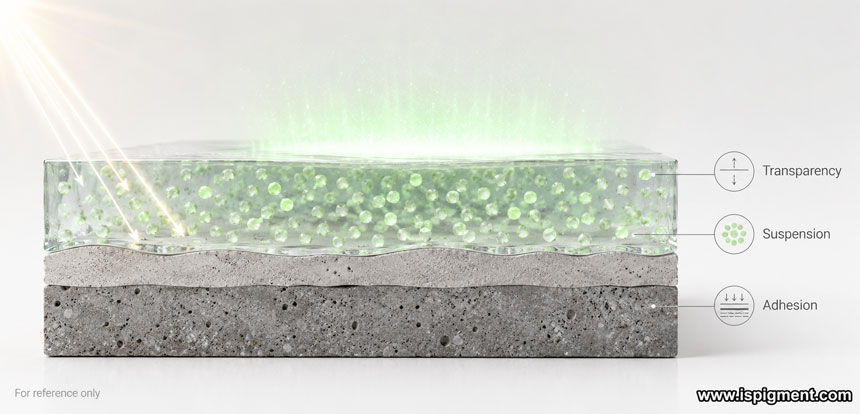
First, the cured binder should have high optical transparency. Glow pigment must absorb excitation light before it can produce an afterglow. A strongly colored or opaque resin increases optical losses, while a clear or lightly tinted binder allows more useful light to reach the pigment and more emitted light to return to the viewer.
Second, the binder must wet and hold a relatively dense inorganic powder. Strontium aluminate is much denser than a typical liquid polymer system, so sedimentation can occur before cure. Simple low viscosity may improve application and wetting, but it can also allow particles to settle faster. Therefore, the useful target is not the lowest possible viscosity; it is a workable formulation with suitable viscosity, thixotropy or yield stress for the selected application method.
Third, the system needs sufficient adhesion to the cured microcement, concrete, plaster or primer. This is especially important for floors, feature walls that may be cleaned frequently, and decorative surfaces protected with a clear topcoat.
Finally, the binder and pigment must be compatible with the service environment. Water exposure is particularly important because untreated SrAl2O4:Eu,Dy phosphor is chemically sensitive to water and can hydrolyze, which changes its structure and optical performance.[1] For waterborne or cementitious systems, a water-resistant or surface-treated luminous pigment can therefore be more important than the generic resin name.
|
Binder system |
Main advantages |
Main limitations |
Best-fit applications |
|
Clear epoxy |
High adhesion, good cohesion, strong mechanical and chemical performance, good clarity in properly formulated grades |
Conventional epoxy may yellow or chalk under prolonged UV exposure; low-viscosity grades can allow rapid settling |
Indoor decorative walls, protected microcement, luminous base or intermediate layers, high-adhesion surface coatings |
|
Aliphatic polyurethane |
Good exterior color retention, flexible film, strong abrasion/weathering potential, useful as a clear protective topcoat |
Formulation-dependent transparency and adhesion; still subject to long-term photooxidation |
Exterior decorative walls, UV-exposed microcement, clear protective topcoats over luminous layers |
|
Water-based acrylic |
Easy application, low odor/VOC potential, fast drying, compatible with many decorative wall systems |
Untreated strontium aluminate can hydrolyze in water; settling must be controlled through rheology |
Interior decorative coatings, breathable wall systems, waterborne formulations using protected pigment |
|
Solvent-based acrylic |
Clear film, relatively fast drying, avoids direct water exposure during application |
Solvent compatibility, VOC and substrate sensitivity must be considered |
Thin decorative luminous coatings where a fast-drying clear film is preferred |
|
Cementitious/mineral binder |
Integrates the glow effect into the microcement body and can provide a natural mineral appearance |
Alkaline/wet hydration environment can affect phosphor; high pigment loading can change hydration and strength |
Specially engineered self-luminous cementitious layers using water-resistant pigment and validated dosage |
This comparison shows why “best binder” should be defined by the application rather than by one universal resin ranking.
For a luminous coating applied over cured microcement or concrete, epoxy has particularly strong academic support. A 2026 study directly compared epoxy and polyurethane resin matrices for photoluminescent coatings on concrete. In the tested system, the epoxy-based coatings provided stronger mechanical and chemical performance and high adhesion to the concrete substrate.[2]
This makes clear epoxy a logical starting point for indoor feature walls, decorative microcement panels, counters, protected flooring zones and other applications where the glow layer needs to form a strong, coherent bond with the base.
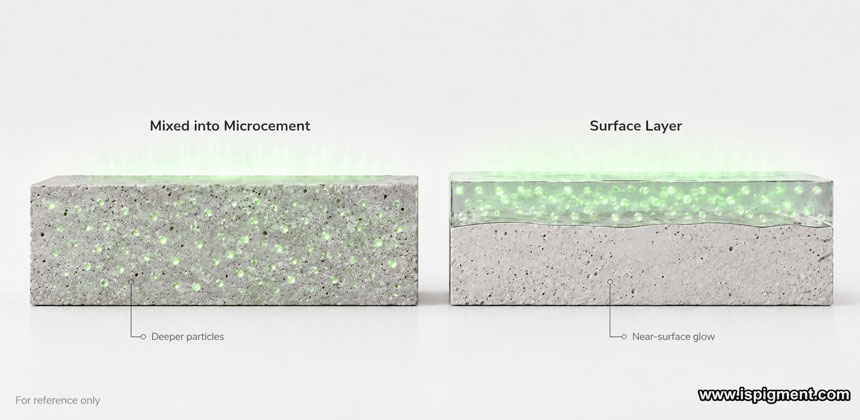
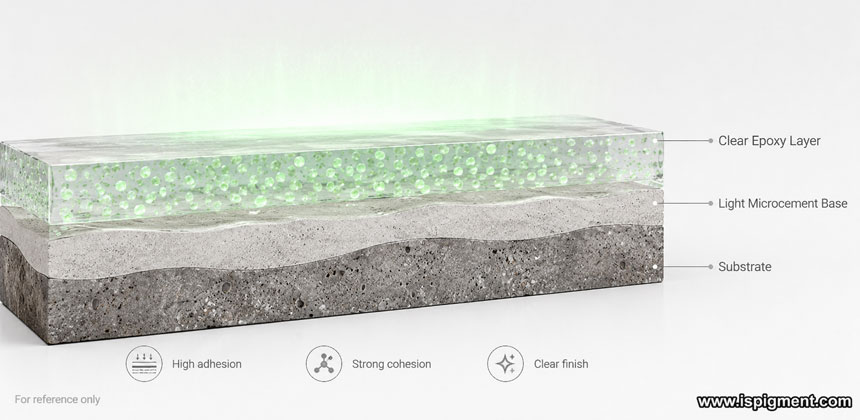
Epoxy is also useful because the luminous pigment can be concentrated near the visible surface instead of being distributed through the full thickness of the mineral substrate. A pigment-rich surface layer can use the glow powder more efficiently: particles buried deeply inside an opaque microcement or concrete matrix contribute much less to the visible afterglow than particles near the surface.
However, “clear epoxy” does not automatically mean “best outdoors.” Conventional DGEBA epoxy coatings can undergo UV-related yellowing and chalking. Accelerated-weathering studies have documented discoloration in unmodified epoxy coatings.[3]
For this reason, an exterior specification may use epoxy for adhesion and luminous-pigment fixation while relying on a compatible aliphatic PU clear topcoat for improved color stability and weathering resistance.
Polyurethane is often recommended for exposed decorative surfaces because it can combine abrasion resistance, flexibility and weathering performance. For a glow-in-the-dark wall or microcement finish, the important distinction is between generic “PU” and an aliphatic polyurethane designed for clear, color-sensitive exterior use.
Aromatic polyurethane chemistries are more prone to light-induced discoloration. Research on aliphatic polyurethane systems shows that aliphatic isocyanate-based materials have a different photooxidative behavior and are used when minimizing visible discoloration is important, although the polymer can still degrade under prolonged UV exposure.[4]
That makes aliphatic PU especially useful in two situations. The first is an exterior luminous coating where the clear binder itself must retain a neutral appearance. The second is a protective topcoat over an epoxy-based luminous layer. In the second configuration, the epoxy can provide strong bonding to the substrate while the PU layer provides the exposed weathering surface.
The main caution is that polyurethane should not be assumed to outperform epoxy in every mechanical property. The 2026 concrete-coating comparison found the tested epoxy matrix superior in mechanical and chemical performance.[2] The practical choice therefore depends on which property has priority: adhesion and cohesive strength, or exterior optical stability and flexibility.
Yes, but it should not be evaluated only by saying that “water-based acrylic is too thin and the pigment will sink.” That explanation combines two different formulation issues: chemical water resistance and physical sedimentation.
The chemical issue is the more fundamental one for untreated strontium aluminate. SrAl2O4:Eu,Dy is sensitive to water, and hydrolysis can damage its crystal structure and luminous performance.[1] Research on waterborne road-marking paint has specifically examined protective coatings for this phosphor and identified durability, transparency, adhesion, compatibility and dispersibility as important requirements for successful use in a wet system.[5]
Therefore, if the decorative wall formulation is water-based, the first question should be whether the luminous pigment grade has been treated or validated for aqueous media and for the pH of the formulation. A standard untreated grade that performs well in solvent-based resin should not automatically be transferred into a waterborne acrylic or cementitious microcement.
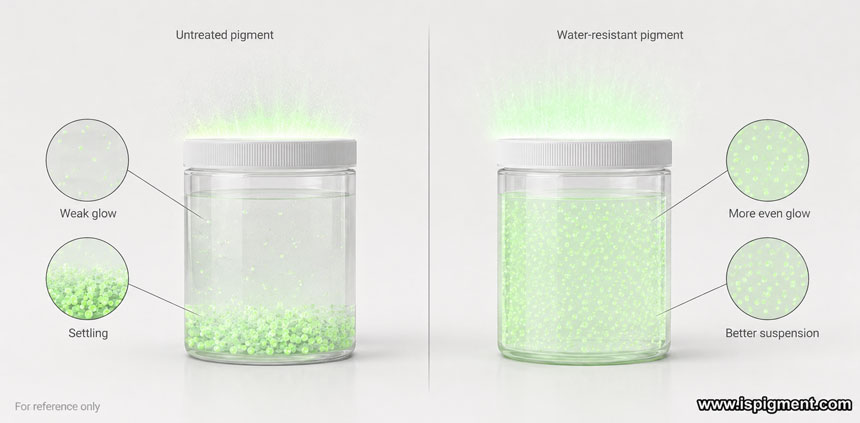
The second issue is settling. Glow powder is an insoluble, relatively high-density particulate material. Its sedimentation behavior depends on particle size, density difference, continuous-phase viscosity, thixotropy or yield stress, wetting and dispersion, pigment concentration and the time available before the coating sets. A low-viscosity acrylic may settle rapidly, but an acrylic system with appropriate rheology modifiers can provide much better suspension.
For vertical decorative walls, this is especially important because the formulation must control both sedimentation in the container and sagging after application. The target should be a stable, brushable, rollable or trowel-compatible rheology—not simply the highest possible viscosity.
This question deserves more attention than it receives in most resin-art or glow-paint guides.
Direct addition into a cementitious microcement layer can create an integrated mineral appearance, but the pigment is exposed to water and an alkaline hydration environment during curing. Studies on self-luminous cement-based materials show that strontium-aluminate phosphor can interact with the cement system and that both particle size and loading affect hydration, strength and luminous performance.
Research has also shown that surface modification can improve the water resistance of long-afterglow phosphors used in cementitious materials. SiO2-coated and organosilicon-modified phosphors have been investigated specifically to improve hydrolysis resistance while maintaining useful luminescent properties.
For many decorative applications, a surface-layer strategy is therefore easier to control. A typical system can use a cured white or light microcement base, by a transparent or translucent pigment-rich resin layer, and then—where needed—a compatible clear protective topcoat. This architecture places more luminous particles near the effective optical surface and reduces the amount of pigment buried in an opaque mineral matrix.
Direct incorporation should not be described as impossible. It is a viable route when the microcement manufacturer, binder supplier and pigment supplier validate water resistance, dosage, hydration behavior, mechanical properties and appearance together. But for a project whose main objective is maximum visible glow with easier formulation control, a dedicated surface luminous layer is often the more practical starting point.
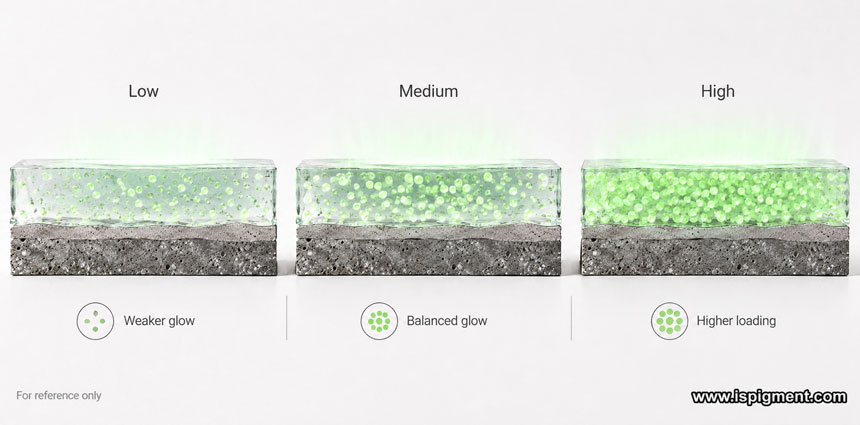
Many commercial guides recommend approximately 20–30% glow powder relative to the binder, while other sources suggest broader ranges. These figures can be useful for laboratory starting trials, but they should not be presented as a universal optimum.
The first reason is that “percentage” can mean different things. It may refer to pigment as a percentage of binder weight, total formulation weight, resin volume or cement mass. These numbers cannot be compared directly.
The second reason is that different systems produce different optima. In the 2026 photoluminescent concrete coating study, five volumetric powder-to-resin ratios were tested, and approximately 75 vol% aluminate powder produced the best balance between luminous intensity and coating durability in that specific system, although mechanical strength decreased as powder concentration increased.[2] By contrast, a 2021 cement-based study reported an optimum luminescent-powder range of approximately 20–25 wt% for its cementitious composite.
The useful B2B recommendation is therefore to treat supplier loading ranges as formulation starting points. Prepare controlled sample panels at several concentrations, keep the percentage basis consistent, and compare afterglow, wet-film handling, cure, adhesion and surface appearance before scaling up.
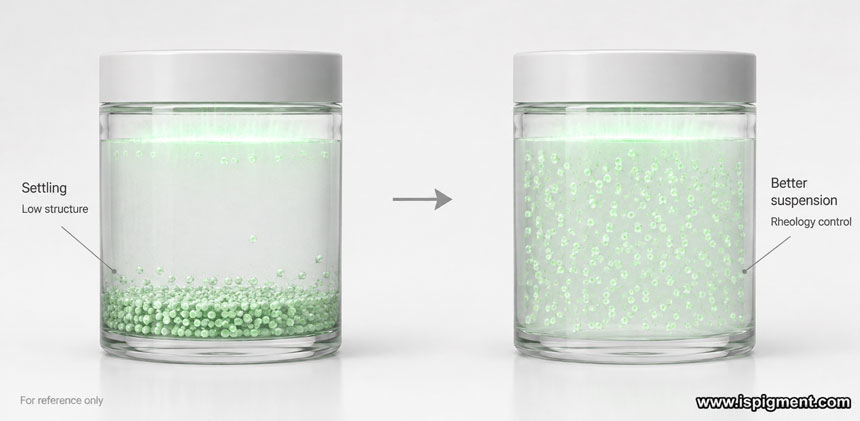
Because luminous powder is denser than most liquid binders, some settling tendency is expected. Increasing viscosity can slow this process, but a formulation that is simply “very thick” may become difficult to disperse, roll or level.
A better approach is to control the complete rheological profile. Depending on the binder technology, formulators can evaluate thixotropic or anti-settling additives, suitable wetting and dispersing agents, smaller batch sizes, controlled application time and gentle re-stirring before use.
Particle size also matters, but statements such as “a certain micron size prevents settling” are too absolute. Research on cement-based luminous composites shows that particle size affects brightness, effective glowing area and interactions with the cement matrix. In liquid resin, finer particles generally settle more slowly than coarse particles under otherwise similar conditions, but density and rheology still determine whether the suspension remains stable.
Mixing should also protect the pigment. High-shear grinding is normally unnecessary for a crystalline glow pigment and can damage particles or change the desired particle-size distribution. The goal is uniform wetting and distribution rather than aggressive size reduction.
A glow-in-the-dark surface has two optical stages: charging and emission. During charging, light must reach the phosphorescent particles. During afterglow, the emitted light must escape from the coating and reach the observer.
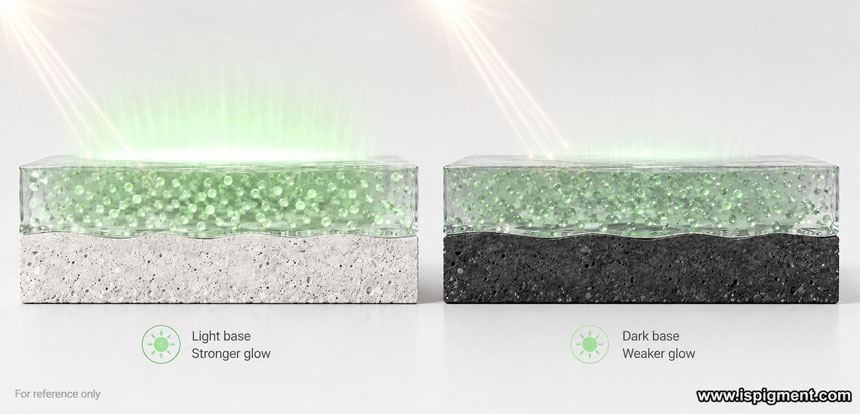
A dark or strongly absorbing background can reduce the visible effect because more light is lost within the system. For this reason, commercial application guides consistently recommend white or light-colored backgrounds, and cement-based research commonly uses white or reflective components when optimizing luminous performance.
For decorative walls and microcement, a practical build-up is therefore often:
1.a white or light-colored, fully cured microcement or primer;
2.a clear or lightly tinted luminous layer containing the glow pigment; and
3.when required, a compatible transparent protective topcoat.
This is not a rule that every artistic project must follow. Dark backgrounds may be intentionally chosen for daytime aesthetics or contrast. But when maximum visible afterglow is the objective, a light, reflective base and a transparent binder usually provide a more efficient optical system.
|
Application |
Recommended starting strategy |
Why |
|
Interior decorative feature wall |
Clear epoxy or compatible clear acrylic with suitable rheology |
Good optical clarity; epoxy provides strong adhesion, while acrylic can offer easier wall-coating application |
|
Exterior decorative wall |
Pigment-rich luminous layer protected with aliphatic PU, or a validated aliphatic-PU luminous binder |
Better control of UV-related discoloration at the exposed surface |
|
Interior microcement floor or high-wear surface |
Strongly bonded epoxy-based luminous layer plus a compatible abrasion-resistant clear coat |
Prioritizes adhesion, cohesion and wear protection |
|
Exterior microcement |
Validated luminous layer over cured microcement plus UV-stable aliphatic PU protection |
Separates substrate bonding from exterior weathering requirements |
|
Water-based decorative coating |
Water-resistant/surface-treated glow pigment in acrylic or PU dispersion with anti-settling rheology |
Addresses hydrolysis and sedimentation as separate formulation problems |
|
Direct addition to cementitious microcement |
Water-resistant modified pigment with carefully validated dosage |
Can create an integrated mineral effect, but hydration, strength and luminous performance must be tested together |
For most decorative wall and microcement projects, the best approach is to choose the binder according to the layer’s job rather than asking for one universal “best resin.”
Use clear epoxy when a luminous surface layer needs strong adhesion and mechanical stability on a cured mineral substrate. Consider aliphatic polyurethane when the exposed surface requires better resistance to UV-related discoloration, especially outdoors. Do not automatically exclude water-based acrylic: it can be suitable when a water-resistant strontium-aluminate grade and appropriate anti-settling rheology are used. For direct incorporation into microcement, treat pigment water resistance and cement compatibility as primary formulation variables.
Most importantly, keep the luminous pigment close to the visible surface, use a sufficiently transparent binder, control settling, and validate loading with sample panels. A well-designed layer structure can have as much influence on the final glow as the nominal resin type itself.
Tag :
direito autoral © 2026 iSuoChem.todos os direitos reservados.
a equipe profissional para atender !
 web@ispigment.com
 +86 13965049124
 português
  English
 français
 русский
 italiano
 español
 العربية
 한국의
한국의 ไทย
ไทย Tiếng Việt


