categorias
Novos Produtos
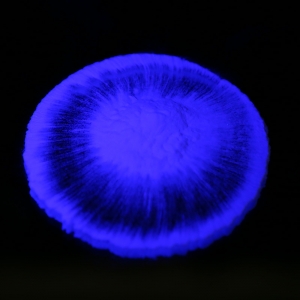
pó fosforescente de aluminato de estrôncio

Fornecedor de pigmento em pó de brilho fosforescente de aluminato de estrôncio roxo

O pigmento fosforescente roxo iSuoChem®, que é um tipo de pó de armazenamento de energia, é certificado pela SGS, ISO17514, DIN67510 Parte 1-4.

Read More
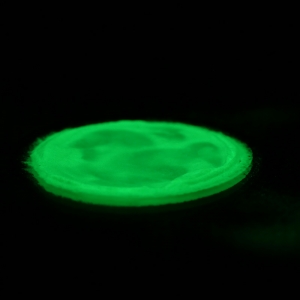
pó luminescente verde

dt pigmento fluorescente verde de coloração luminescente

pó de armazenamento de energia, isuochem & reg; O pigmento luminoso brilha no escuro depois de absorver a luz visível diferente e pode reutilizar repetidamente. Certificados de sgs, iso17514, din67510 parte 1-4 estão disponíveis.

Read More
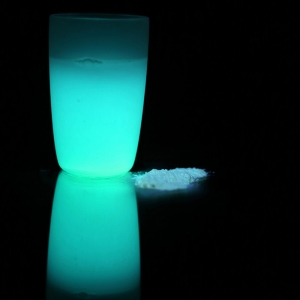
pigmento fotoluminescente fluorescente

Cerâmica fotoluminescente azul esverdeada brilha no pigmento escuro

O pigmento fotoluminescente fluorescente iSuoChem® brilha na cor azul-esverdeada no escuro depois de absorver luz visível diferente e pode ser reutilizado repetidamente.

Read More
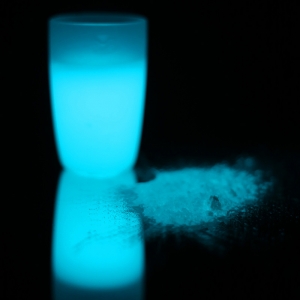
pó de brilho de aluminato de estrôncio para plástico

Atacado de aluminato de estrôncio azul esverdeado brilho no pó escuro

O pó iSuoChem® brilha no escuro brilha com luz azul-esverdeada no escuro depois de absorver diferentes luzes visíveis e pode ser reutilizado repetidamente.

Read More
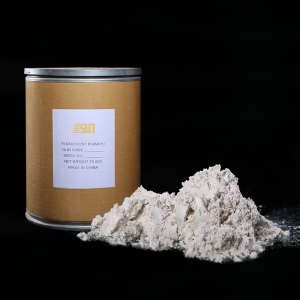
pó de mica branco prateado para impressão de tinta

Base de mica esterlina de rutilo fino fabricante de pigmento pérola branca prata

Registro REACH, SGS, certificação ISO, baixo teor de metais pesados, consistência de cor de 95% min, teste de tamanho de partícula Malvern, teste de cor e brilho X-RITE, teste QUV, para garantir boa qualidade do pigmento perolado.

Read More
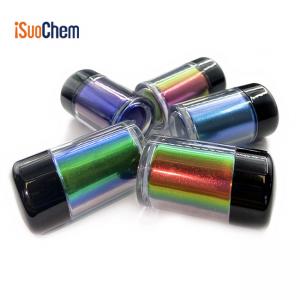
Pigmento Multicromático

Pigmento multicromático de mudança de cor de metal refrativo iSuoChem

Os pigmentos multicromáticos iSuoChem® são um tipo especial de pigmento que tem a propriedade de mudar de cor conforme a luz muda.

Read More
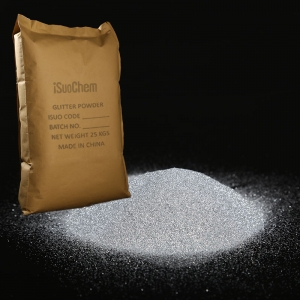
Pó glitter espumante prateado

Pó de glitter em massa prateado espumante hexágono

O pó de glitter iSuoChem® YS1001 Silver Sparkling está em conformidade com SGS, REACH, OEKO-TEXT Standard 100, formaldeído livre, bisfenol A livre, resistente a solventes, resistente a altas temperaturas, cores da moda, vários pós de glitter para sua escolha.

Read More
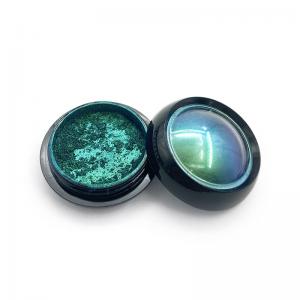
Pigmento de tinta óptico mutável

Pigmento lnk mutável óptico de alta intensidade de cor roxo/martim-pescador/azul

O pigmento de segurança iSuoChem® HC17 é um tipo de  pigmento de tinta óptica mutável (OCIP) ,  pigmento opticamente variável (OVP) e pigmento magnético opticamente variável (OVMP) .

Read More
How to Choose the Right Thermochromic Pigment: A Buyer's Checklist

Jul. 10,2026

Choosing thermochromic pigment for a real B2B project comes down to five decisions: activation temperature, base color, particle size, heat and light resistance, and carrier compatibility. Miss any one and the effect will look weak, fade fast, or fail on the production line. The checklist below is written for procurement, R&D, and marketing teams that need to sign off a pigment before production. Suppliers such as iSuoChem are used as a reference because their pigment portfolio publishes activation curves, particle size, and carrier compatibility for each grade.

iSuoChem thermochromic pigment buyer checklist for procurement teams

Step 1: Fix the activation temperature

  • Cold reveal (drink cups, ice packaging): 5 °C to 15 °C.
  • Body-heat reveal (mugs, packaging, novelty): 25 °C to 35 °C.
  • Warm-liquid reveal (tea, coffee): 40 °C to 55 °C.
  • Hot surface warning (kitchenware, tools): above 60 °C.

Ask the supplier for the activation curve, not only a single number. A quality curve shows the transition span and the reset behaviour after cooling.

Step 2: Pick the base color and reveal color

Reversible thermochromic pigment usually goes from a strong base color to clear (or a lighter shade) above the activation temperature. To create a 'A to B' effect, print or mold a stable base color underneath and place the thermochromic layer on top. This is why base color choice must be planned with the artwork designer, not only the pigment supplier.

Step 3: Match particle size to process

Process Recommended D50 Common issue if wrong
Screen printing 5–10 μm Mesh clogging if too coarse
Flexo / gravure 2–5 μm Uneven ink film
Plastic masterbatch 5–15 μm Poor dispersion or specks
Water-based coating 5–10 μm Sedimentation if too coarse

Step 4: Confirm heat and light performance

  • Heat resistance: check both peak temperature and residence time.
  • Light-fastness: indoor use is easier; outdoor use needs a UV top layer.
  • Fatigue: ask for cycle test data at 200 and 500 cycles.
  • Storage: sealed, away from direct sunlight, ideally under 25 °C.

Step 5: Test carrier compatibility

Always run a compatibility test in the real ink, coating, or plastic system. Some solvents dissolve the microcapsule, some resins react with the leuco dye, and some plastic additives shift the activation point. A lab-scale trial is faster and cheaper than a failed batch.

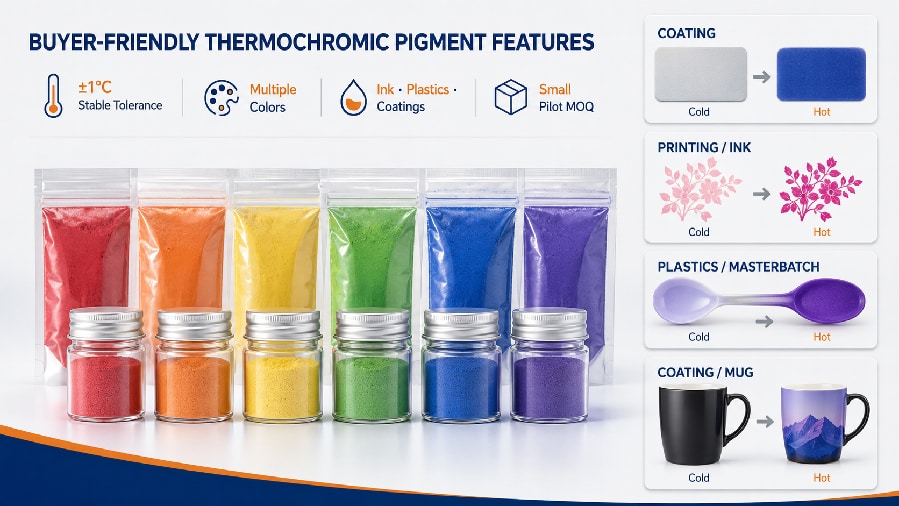
iSuoChem thermochromic pigment: buyer-friendly features

  • Wide range of activation temperatures with stable ±1 °C tolerance on standard grades.
  • Multiple base colors (black, red, blue, magenta, orange, green, and custom blends).
  • Grades tuned for water-based ink, solvent ink, UV ink, plastisol, plastic masterbatch, and PU or acrylic coating systems.
  • Same catalog covers mica powder, glitter powder, pearlescent pigment, and glow pigment for combined effects.
  • Small pilot MOQ for sampling, with documented particle size, heat resistance, and application notes on https://www.ispigment.com/.

Buyer's final sign-off checklist

Item Confirmed? Notes
Activation temperature and tolerance    
Base color and reveal color    
Particle size fit for process    
Heat resistance vs. real process    
Light-fastness for use environment    
Fatigue after 200–500 cycles    
Carrier compatibility test passed    
MOQ, lead time, and price agreed    
Documentation (COA, TDS, safety)    

FAQ

Q: How many samples should I order before mass production?
A: Two or three grades close to the target activation temperature and particle size, tested in the real ink or resin system. That is enough to lock down a spec.

Q: How long does a thermochromic printed product last?
A: Indoor use typically 1–3 years with a UV top layer. Outdoor use is shorter and depends on UV protection and cycle frequency.

Q: Can activation temperature be customized?
A: Yes, most suppliers can tune activation points within the practical range from about -15 °C to 65 °C, with longer lead time for custom grades.

Q: Which iSuoChem website should be linked?
A: Use https://www.ispigment.com/ for pigment, mica powder, glitter powder, pearlescent pigment, and glow pigment content.

For the full thermochromic pigment portfolio, activation charts, and application guides, visit https://www.ispigment.com/.

Entre em contato conosco agora